June 30, 2026
Verified Reviews in the AI Shopping Era: What Shopify and Amazon Sellers Should Fix Now
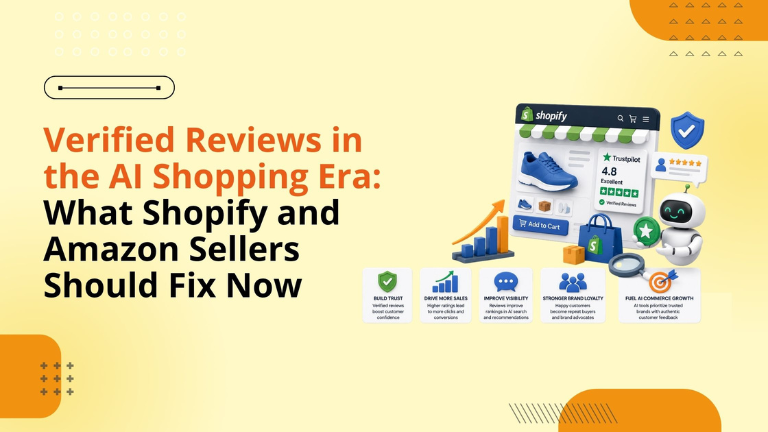
AI shopping is changing how customers discover and evaluate products.
In the past, shoppers usually searched on Google, clicked a website, read a product page, checked reviews, and then made a purchase decision. That journey is becoming less direct.
Today, AI assistants and shopping engines can summarize products, compare merchants, read review signals, and recommend options before a shopper ever lands on a product page.
That is why Shopify’s Trustpilot integration matters.
By making verified reviews easier to display and manage inside Shopify storefronts, Shopify is helping merchants strengthen one of the most important signals in modern ecommerce: trust.
For Amazon and Shopify sellers, this is a clear reminder. Product pages must now be built not only for human shoppers, but also for AI systems that read, interpret, and recommend products.
Reviews have always influenced conversion.
But in the AI shopping era, verified reviews can also help support discovery. AI systems need reliable information to decide which products, brands, and merchants are worth showing to customers.
This means reviews are becoming more than social proof. They are becoming structured trust signals.
For Shopify brands, verified Trustpilot reviews can support storefront credibility. For Amazon sellers, customer reviews, Q&A, attributes, product content, and listing accuracy all work together to help shoppers and AI tools understand the product.
A strong Shopify foundation through Shopify Store Management can help brands connect storefront trust, product content, and conversion strategy.
Shopify merchants should treat verified reviews as part of their conversion and discovery strategy.
A storefront with strong product descriptions, clear images, customer reviews, trust badges, and clean navigation gives shoppers more confidence.
It also gives AI systems more structured information to understand the business.
Brands should review product pages, review placement, schema, FAQs, product descriptions, and collection pages. Strong Shopify Product Listing Optimization can help ensure product pages are clear, searchable, and conversion-focused.
Amazon sellers should not ignore this shift.
The same AI-led shopping behavior is also shaping marketplace discovery. Amazon listings need to be clear, attribute-rich, and easy to interpret.
That means sellers should review titles, bullet points, backend keywords, product attributes, A+ Content, images, reviews, and Q&A.
Strong Amazon Content Optimization helps sellers make listings more useful for both shoppers and AI-driven search systems.
Better Amazon Image Optimization also supports faster product understanding, especially when shoppers compare options quickly.
In AI-led commerce, the product page still matters, but its job is changing.
It must clearly answer:
If your product content does not answer these questions clearly, AI tools may summarize your product poorly or skip it in favor of a competitor with stronger signals.
First, audit your review strategy.
Make sure reviews are visible, credible, and connected to the right product pages.
Second, improve structured product content.
Your descriptions, attributes, FAQs, and benefits should be easy to read and easy to extract.
Third, strengthen the marketplace and DTC alignment.
If your Shopify store and Amazon listing tell different stories, customers and AI tools may receive mixed signals.
Fourth, monitor sessions, conversion rate, branded search, and ranking together.
Traffic changes may indicate that shoppers are getting answers before reaching your product page.
A stronger Multi-Channel Integration strategy can help sellers connect Shopify, Amazon, and other ecommerce channels more clearly.
Big Internet Ecommerce helps ecommerce brands prepare for AI-powered shopping and multi-channel growth.
Our team reviews Shopify stores, Amazon listings, product content, reviews, images, SEO, conversion gaps, and marketplace performance.
The goal is simple: help brands become easier to find, easier to trust, and easier to buy from across every channel.
Verified reviews help provide trustworthy customer feedback that AI tools may use when comparing brands, merchants, and products.
Yes. It signals a broader ecommerce shift where AI systems value structured trust signals, product clarity, and reliable customer feedback.
Start with reviews, product attributes, listing content, product images, FAQs, and consistency across Amazon and Shopify.
Need help making your product pages ready for AI-driven shopping?
Schedule a strategy call with our team.
Follow Big Internet Ecommerce (BIE) on Instagram & LinkedIn to stay updated with the latest trends in Amazon selling.
Fill out the form and our experts will get back
to you within 24 hours.
.webp)
.webp)
.webp)
We respect your privacy. Your information is safe with us.