August 13, 2026
Shopify’s Shop App Holiday Push: What Amazon Sellers Should Change Before Q4 Gets Competitive
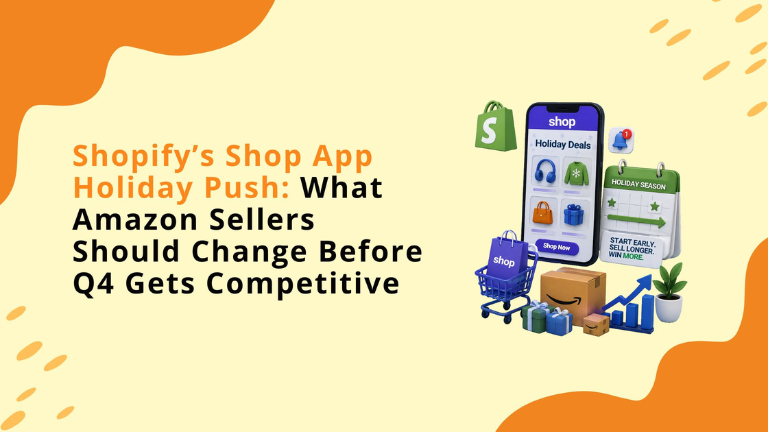
For years, many ecommerce brands planned Q4 around one major peak: Black Friday and Cyber Monday.
That approach is becoming too narrow.
Shopify is expanding how merchants can promote offers through the Shop app, Shop Campaigns, and external discovery channels. This means holiday demand may start earlier, move across more surfaces, and become more competitive before many Amazon sellers are fully ready.
For Amazon-first brands, this matters.
Even if Shopify is your secondary channel, your customers do not think in channels. They compare offers, shipping speed, reviews, discounts, and product pages wherever they find you.
That means your Amazon plan and Shopify plan cannot sit in separate folders anymore.
If Shopify helps merchants push deals earlier and across more discovery points, Amazon sellers need to review inventory, promotions, margins, PPC budgets, and listing readiness before the holiday season becomes crowded.
Shopify’s Shop app gives shoppers a place to discover products, track orders, buy through Shop Pay, and engage with brands.
Now Shopify is giving merchants more ways to surface offers inside that shopping environment.
The Deals Feed helps merchants show discounts to shoppers browsing inside Shop. Shopify’s own guidance explains that merchants can make discount codes visible in Shop by allowing sales channel access for selected discounts.
This gives brands another placement for promotional visibility.
For sellers, the important point is simple: discounts are becoming more discoverable inside the buying journey, not only through email, paid ads, or the brand’s own website.
That can influence when customers shop and where they compare offers.
Shop Campaigns is Shopify’s pay-per-sale advertising program.
Instead of paying for every click, merchants pay when a customer converts through the campaign.
Shopify says Shop Campaigns has driven over 10 million sales for merchants. The program can run through Shop and Shopify Product Network, with optional reach across external platforms such as Google, Meta, Pinterest, ChatGPT, and open web placements.
For brands used to Amazon PPC, this changes the way acquisition cost is framed.
Amazon Sponsored Ads charge per click.
Shop Campaigns is built around paying for successful customer acquisition.
That sounds cleaner, but sellers should be careful.
A pay-per-sale model still needs margin discipline.
If the product requires a deep discount, has expensive fulfillment, or attracts high returns, the campaign can still reduce profitability.
The metric that matters is not “Did we pay per click or per sale?”
The metric that matters is “How much profit did each order actually keep?”
Most Amazon sellers who operate DTC stores still treat Shopify as a secondary channel.
That can be a mistake during Q4.
A Shopify promotion can influence Amazon in several ways:
Even if the sale does not happen on Amazon, the shopper may still discover, compare, or validate the product there.
This is why Amazon sellers need a full-channel view.
A seller who plans only for a late-November peak may miss the earlier movement.
If Shopify’s promotional engine helps pull demand into October, then restocking in November is already late.
This matters because Amazon inventory decisions need time.
You need time for:
If the demand window expands, the preparation window must move earlier too.
The sellers who win Q4 are usually not the ones who react fastest. They are the ones who prepared before the spike.
One of the biggest mistakes sellers make is comparing Amazon and Shopify by revenue alone.
Revenue does not tell the full story.
For Amazon, you need to account for referral fees, FBA fees, storage, ads, coupons, returns, and deal discounts.
For Shopify, you need to account for payment processing, fulfillment, returns, app costs, discounts, ad cost, customer service, and any pay-per-sale campaign cost.
A Shopify order may look more profitable because there is no Amazon referral fee.
But if the customer required a large discount and paid acquisition cost, the profit may be lower than expected.
An Amazon order may look more expensive because PPC generated the sale.
But if that sale also improves ranking, supports velocity, and drives repeat behavior, the full value may be stronger.
That is why sellers should compare contribution margin by SKU and by channel.
Not blended ROAS.
Not total revenue.
Not gross sales.
Actual profit after the real cost of the order.
Not every SKU deserves a holiday deal.
Before joining any deal feed, coupon push, Amazon promotion, or pay-per-sale campaign, sellers should classify products by margin strength.
Ask:
A deal placement is only valuable if the product can handle the economics.
A high-revenue promotion with poor margin is not growth. It is an expensive volume.
If you sell on both Amazon and Shopify, your promotional calendar should be coordinated.
Customers compare.
If your Shopify discount is much stronger than Amazon, Amazon conversion may drop.
If Amazon has a better price, your Shopify campaign may struggle.
If inventory is not allocated correctly, one channel may stock out while the other still has demand.
If messaging is inconsistent, customers may lose trust.
This does not mean every price must be identical.
It means the strategy should be intentional.
Your team should know which channel is meant to acquire new customers, which channel is meant to protect ranking, which channel is meant to improve margins, and which products should be pushed where.
A stretched holiday season needs faster review cycles.
Do not wait until the campaign ends to decide what worked.
Review performance every week during the buildup.
Track:
This gives you time to adjust before the season is over.
If a SKU is moving faster than expected, protect inventory.
If a promotion is bringing unprofitable volume, reduce it.
If Amazon PPC is rising but conversion is dropping, check pricing and competitor offers.
If Shopify deals are converting better, review whether Amazon content or price needs adjustment.
Amazon sellers should take this Shopify update as a planning signal.
Start with these actions:
This is how sellers move from reactive holiday selling to controlled seasonal growth.
We help Amazon sellers and D2C brands grow through PPC management, Amazon SEO, listing optimization, A+ Content, catalog health, Store Management, creative strategy, and full-service marketplace support.
For brands selling across Amazon and Shopify, growth cannot be managed in isolation.
Amazon affects Shopify.
Shopify affects Amazon.
Pricing affects conversion.
Inventory affects PPC efficiency.
Discounts affect margin.
Content affects customer trust.
Reviews affect every channel.
That is why Q4 planning should include more than an ad budget.
It should include listing readiness, creative strength, inventory coverage, deal strategy, SKU-level profitability, and channel-by-channel decision-making.
We help sellers identify where the business is ready to scale and where hidden risks may hurt performance.
Because many Amazon sellers also run Shopify stores, and shopper demand can move across channels. A stronger Shopify deals push can affect Amazon pricing, conversion, inventory, and promotional timing.
The Deals Feed is a Shop app placement where shoppers can discover discounts and offers from participating merchants.
Shop Campaigns is Shopify’s pay-per-sale advertising program. Merchants set acquisition costs and pay when a customer converts through the campaign.
Not automatically. Pay-per-sale can be attractive, but sellers still need to calculate profit after discounts, fulfillment, returns, and campaign costs.
Review SKU margin, inventory, discount depth, reviews, conversion rate, PPC budget, fulfillment capacity, and channel-level profitability.
Big Internet Commerce can help Amazon sellers review PPC, listings, A+ Content, promotional readiness, catalog health, and Q4 growth opportunities across marketplace and DTC channels.
Shopify’s Shop app and Shop Campaigns push is a reminder that holiday demand is spreading beyond one concentrated shopping weekend.
For Amazon sellers, that means the old Q4 playbook needs to be updated.
Do not wait for late-season traffic to start planning.
Do not compare Amazon and Shopify by revenue alone.
Do not run discounts without checking the margin.
Do not let inventory planning lag behind demand.
Do not review performance only after the season ends.
The brands that prepare earlier, compare channels properly, and manage promotions by profit will be in a much stronger position.
We can help you review your Amazon listings, PPC campaigns, A+ Content, inventory risk, promotional strategy, and marketplace growth plan before Q4 pressure builds.
Schedule a strategy call with our team.
Follow Big Internet Ecommerce (BIE) on Instagram & LinkedIn to stay updated with the latest trends in Amazon selling.
Fill out the form and our experts will get back
to you within 24 hours.
.webp)
.webp)
.webp)
We respect your privacy. Your information is safe with us.