June 23, 2026
Prime Day Follow-Through: How Amazon Sellers Can Protect Pricing, Profit, and Buy Box Momentum
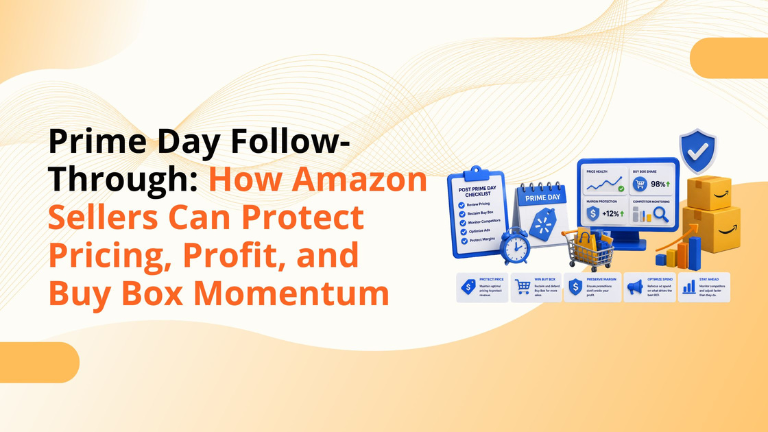
Prime Day Creates the Sales Spike. Your Pricing Plan Protects the Profit.
Prime Day is one of the biggest growth moments for Amazon sellers. Brands prepare inventory, deals, coupons, PPC campaigns, and listing updates to capture as much traffic as possible.
But the real profit test starts immediately after the event.
Many sellers focus heavily on Prime Day execution but do not plan what happens next. That is where pricing mistakes begin. A rushed price increase, forgotten coupon, unchecked PPC budget, or panic inventory discount can reduce the profit earned during the event.
A strong Prime Day pricing strategy should include both event-day planning and the follow-through period that protects margin, Buy Box share, and future deal eligibility.
Amazon pricing does not reset in isolation.
Your price changes can affect Buy Box performance, customer conversion, competitor positioning, and future promotion planning. If pricing is handled without data, sellers can quickly lose momentum.
This is why post-event pricing should be treated as a controlled transition, not a quick return to normal.
A structured review through Amazon Store Management can help sellers understand which ASINs should recover price, which need continued support, and which need inventory movement.
A sudden price jump can hurt conversion and Buy Box stability. Instead of moving directly back to full price, review demand, competitor pricing, and conversion rate before making changes.
Leaving Prime Day offers active for too long can reduce profit and train shoppers to expect a lower price. Check every coupon, deal, promotion, and discount after the event.
Deep discounts can influence how Amazon evaluates future promotional pricing. Sellers should track recent price history before planning the next major sales event.
Prime Day PPC bids are often higher because traffic and competition increase. Once traffic normalizes, those same bids can become expensive. A PPC review through Amazon Advertising PPC Services can help control wasted spend.
Leftover stock does not always mean the price needs to be cut heavily. Sellers can use coupons, bundles, Subscribe & Save, or targeted ads instead of lowering the base price too far.
Competitors may keep discounts active longer or shift prices quickly. Sellers should monitor competitor offers and respond based on margin, not emotion.
If your Shopify, Walmart, or other marketplace pricing does not match your Amazon strategy, shoppers may lose trust or choose another channel. Multi-Channel Integration can help keep pricing and inventory aligned.
Not every ASIN needs the same pricing decision. Review sales, margin, conversion rate, ad spend, inventory, and returns before changing prices.
A product can generate strong sales and still lose money after ads, fees, discounts, and returns. Sellers should review net margin and TACoS before deciding whether to scale or pull back.
Manual pricing can be too slow, but uncontrolled automation can damage margin. Use price floors, ceilings, and clear rules so automation supports profit instead of chasing sales blindly.
Pricing alone cannot protect profit if the listing is weak.
If conversion drops after Prime Day, sellers should also review titles, bullets, images, reviews, and A+ Content. Better Amazon Content Optimization can help maintain conversion without relying only on discounts.
Strong visuals through Amazon Image Optimization can also support click-through and customer confidence during the pricing reset period.
Big Internet Ecommerce helps Amazon sellers manage pricing, PPC, listings, and profitability before and after major sales events.
Our team reviews SKU-level performance, Buy Box risk, competitor pricing, PPC efficiency, inventory movement, and conversion gaps.
The goal is simple: help sellers keep Prime Day momentum while protecting long-term profit.
Because pricing decisions after Prime Day can affect profit, Buy Box share, PPC efficiency, and future promotional opportunities.
Not always. A gradual pricing reset is usually safer than one sharp increase.
Start with active discounts, PPC budgets, SKU-level profit, competitor pricing, inventory levels, and Buy Box performance.
Need help protecting your Amazon profit after Prime Day?
Schedule a strategy call with our team.
Follow Big Internet Ecommerce (BIE) on Instagram & LinkedIn to stay updated with the latest trends in Amazon selling.
Fill out the form and our experts will get back
to you within 24 hours.
.webp)
.webp)
.webp)
We respect your privacy. Your information is safe with us.