July 10, 2026
Amazon SEO on Autopilot Is Expensive: How Stale Listings Drain Profit and Ranking Power
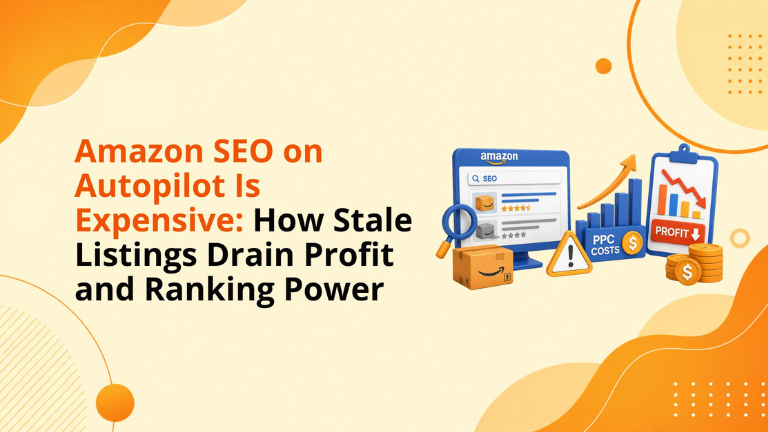
Your Amazon listing may still be active, but that does not mean your SEO is still helping you grow.
Many sellers optimize a product listing once, launch the ASIN, and assume the work is finished. The title is written, bullets are filled, backend keywords are added, and the product starts ranking. But Amazon does not stay still. Customer search behavior changes, competitors improve their listings, keyword demand shifts, reviews reveal new buyer language, and advertising costs continue to rise.
This is where “set it and forget it” Amazon SEO becomes expensive.
At first, the damage may not be obvious. Sales may still come in, but organic traffic slowly weakens. PPC begins carrying more of the revenue. TACoS starts rising. Conversion becomes harder to maintain. Over time, sellers may realize they are paying more to earn the same sales they once received organically.
That is why ongoing Amazon SEO is not only a ranking strategy. It is a profit protection strategy.
We will explain why one-time Amazon SEO stops working, how stale listings increase advertising dependence, which SEO signals change over time, and how sellers can build a continuous optimization process that protects rankings, traffic, and margins.
Amazon SEO is not a launch checklist that can be completed once and ignored.
It is an ongoing process that needs regular updates based on shopper behavior, competitor movement, conversion data, keyword trends, and marketplace changes.
A listing that performed well six months ago may not match today’s search demand. A keyword that once drove traffic may lose relevance. A competitor may improve their images, add stronger A+ Content, lower their price, or target new search terms through PPC.
If your listing stays unchanged while the category moves forward, your product slowly becomes less competitive.
A strong Amazon SEO strategy should keep your listings aligned with the current marketplace, not just the keyword research used at launch.
The biggest danger of stale SEO is that it rarely looks like an emergency at first.
Your rankings may not disappear overnight. Instead, your listing may slowly lose search visibility, click share, and conversion strength.
When organic sales decline, many sellers increase PPC spend to maintain revenue. This may keep sales looking stable in the short term, but it can weaken margins.
You may still be selling, but every order costs more to generate.
That is how stale SEO quietly turns into a profitability problem.
PPC is valuable, but it should not be used to cover weak SEO forever.
When your organic rankings fall, paid ads often become the main source of traffic. This can create a cycle where sellers spend more to maintain the same sales volume.
The problem is that PPC costs money every time a shopper clicks.
If your listing does not rank organically for important keywords, you may end up paying for traffic that used to come naturally. Over time, this can increase ACoS, raise TACoS, and reduce real profit.
A smarter Amazon Advertising PPC Services strategy uses PPC data to improve SEO, not replace it.
Amazon is a competitive marketplace.
Your competitors are not waiting. They are testing new images, refreshing titles, improving bullet points, adding A+ Content, changing pricing, monitoring reviews, and using PPC data to find new keyword opportunities.
If they improve while your listing stays the same, Amazon may begin rewarding their listing with better visibility.
This is why ongoing SEO matters.
Your ranking position is not only based on your product. It is also based on how your product performs compared with other listings in the same search results.
Shoppers do not always use the same words to search.
Search terms change because of trends, seasons, product education, social media influence, competitor messaging, and customer awareness. A keyword that was strong last quarter may become less valuable later.
Sellers should regularly review Search Query Performance, Brand Analytics, PPC search term reports, keyword rankings, and customer review language.
The goal is to understand how customers are searching now, not how they searched when the listing was first created.
Customer reviews are a powerful source of SEO and content insights.
Positive reviews can show which benefits customers care about most. Negative reviews can show where shoppers are confused or disappointed.
If customers keep mentioning size, material, compatibility, packaging, durability, scent, flavor, fit, or use case, those points may need to be clearer in the listing.
This is where Amazon Content Optimization becomes important.
Strong listing content should use real customer language while still staying clear, persuasive, and compliant.
Amazon SEO is not only about keywords.
If shoppers click your listing but do not buy, your conversion rate can weaken. Lower conversion can make it harder to maintain strong organic rankings.
That means images, A+ Content, comparison charts, infographics, and product education all play a role in SEO performance.
Strong Amazon Image Optimization helps shoppers understand the product faster. Clear A+ Content helps answer questions, build trust, and reduce buying hesitation.
Better content can improve conversion, and stronger conversion can support better ranking performance.
Weekly SEO checks help sellers catch early warning signs before performance drops become serious.
Sellers should review:
If impressions are strong but clicks are weak, the issue may be image, title, price, or reviews.
If clicks are steady but conversions are dropping, the issue may be content, pricing, offer strength, competitor ads, or customer trust.
Monthly SEO reviews should focus on deeper improvements.
This includes title structure, bullet quality, backend keywords, A+ Content, image strategy, competitor listing changes, review trends, catalog issues, and indexing gaps.
Sellers should remove outdated terms, add proven search terms, improve clarity, and test better content where needed.
The goal is not to rewrite the listing every few days.
The goal is to make controlled improvements based on data.
A full Amazon Store Management approach helps sellers connect SEO, PPC, inventory, pricing, listing quality, and account performance.
A new Amazon brand should not use the same SEO strategy as an established catalog.
New brands should focus on core indexing, long-tail keywords, product clarity, and building early conversion data.
Growing brands should focus on keywords where they are close to page-one visibility. These “strike zone” terms can often create strong growth when supported by PPC and listing improvements.
Established brands need stronger catalog audits, defensive keyword tracking, brand-term protection, competitor monitoring, and content consistency across multiple ASINs.
As the business grows, SEO needs to become more structured.
Sellers should not judge SEO only by total revenue.
Revenue can hide problems if more sales are being generated through paid ads.
Better SEO metrics include:
These metrics show whether your listing is becoming easier to find and easier to buy without depending too heavily on PPC.
One major mistake is treating SEO as a one-time project.
Another mistake is relying too heavily on PPC while ignoring organic visibility.
Some sellers stop optimizing once they reach page one, but rankings are never permanent. Competitors can take those positions if they improve faster.
Keyword stuffing is another common issue. Adding too many keywords can make the listing harder to read and reduce conversion.
Sellers should also avoid depending completely on automation. Tools can help with research, but human strategy is still needed to understand customer intent, product positioning, and persuasive messaging.
Once the listing basics are strong, sellers should use PPC data to improve SEO.
Search terms that drive profitable conversions in advertising can help guide listing updates. These keywords may be added naturally into titles, bullets, backend search terms, A+ Content, or image text where appropriate.
Sellers should also update SEO around seasonal demand, holiday events, Prime Day, new trends, and competitor movement.
Testing is also important. Sellers can use controlled experiments to compare content changes and understand what improves performance.
The best SEO process is simple:
Research, update, test, measure, and refine.
Big Internet Ecommerce helps Amazon sellers build ongoing SEO systems that protect visibility and profitability.
Our team reviews keyword rankings, Search Query Performance, PPC search terms, competitor listings, content gaps, image strategy, backend keywords, A+ Content, catalog health, and conversion performance.
We help sellers reduce unnecessary PPC dependence, improve organic traffic, and keep listings aligned with changing marketplace demand.
The goal is simple: make your Amazon listings work harder every month, not just at launch.
Ongoing Amazon SEO is the regular process of reviewing and improving listings based on keyword trends, customer behavior, competitor movement, PPC data, and conversion performance.
One-time SEO becomes outdated because shopper search terms, competitor listings, Amazon ranking signals, and customer expectations change over time.
Important metrics should be checked weekly, while deeper listing updates can be reviewed monthly or biweekly depending on category competition.
Yes. PPC search term reports can reveal high-intent keywords that may be useful for organic listing optimization.
Yes. Strong organic rankings can reduce overdependence on paid ads, while stale SEO can increase PPC costs and reduce profit margins.
Are your Amazon listings still relying on old SEO work?
Schedule a strategy call with our team.
Follow Big Internet Ecommerce (BIE) on Instagram & LinkedIn to stay updated with the latest trends in Amazon selling.
Fill out the form and our experts will get back
to you within 24 hours.
.webp)
.webp)
.webp)
We respect your privacy. Your information is safe with us.