July 31, 2026
Amazon PPC Default Bids: The Hidden Auto-Campaign Leak That Can Drain Profit
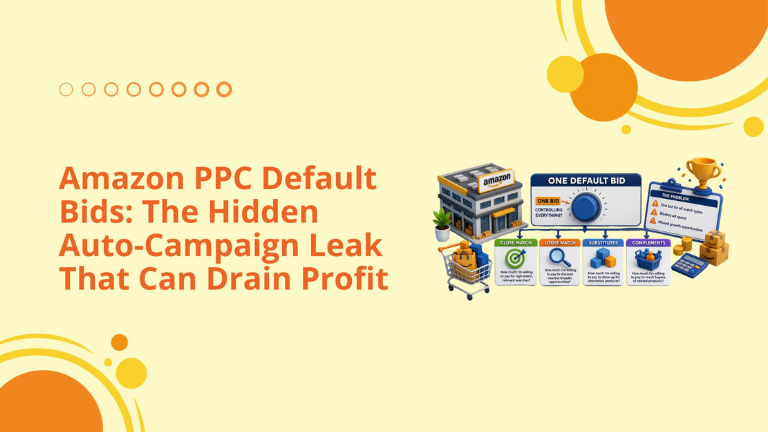
Many Amazon sellers increase PPC budgets before understanding where the money is actually going.
An automatic Sponsored Products campaign may keep getting clicks, CPC may slowly rise, and spend may increase every week. But sales do not always grow at the same pace.
That is often where the default bid becomes a problem.
In an Amazon auto campaign, one default bid can control four different targeting groups: close match, loose match, substitutes, and complements. These traffic types do not carry the same buyer intent, conversion rate, or profit potential.
When all four groups share the same bid, the campaign may overpay for weak traffic while underbidding the shoppers most likely to buy.
This blog explains how Amazon PPC default bids work, why one bid can create wasted spend, how to calculate a break-even CPC, and what sellers should review before increasing campaign budgets.
The default bid is often treated like a simple campaign setup field.
But in an automatic campaign, it can influence how aggressively Amazon spends across different types of traffic.
That matters because not all auto-targeting traffic is equal.
A shopper searching for a term closely related to your product is very different from a shopper viewing a loosely related complementary item. Yet many sellers allow both traffic types to operate under the same bid.
This creates a budget allocation problem.
Strong traffic may not receive enough bid support, while weaker traffic may consume spend before the campaign reaches better buying opportunities.
An Amazon PPC default bid is the base cost-per-click bid used when a target does not have its own custom bid.
In manual campaigns, sellers often set individual keyword or product-target bids. In those cases, the default bid works more like a fallback.
In automatic campaigns, however, Amazon chooses where ads may appear based on product relevance and shopper behavior.
Automatic targeting can include:
If sellers do not separate bids for these groups, one default bid may influence all of them.
That is why the default bid should not remain untouched after a campaign has collected meaningful data.
Amazon automatic campaigns are useful because they can discover search terms, product placements, and new traffic opportunities.
But each targeting group has a different role.
Close match usually connects your ad with shoppers searching for terms closely related to your product.
This traffic often has stronger purchase intent because the shopper is already looking for something similar.
If close match is converting profitably, it may deserve the highest bid among the four auto-targeting groups.
However, sellers should still use actual performance data. Relevance alone does not guarantee profitability.
Loose match helps Amazon explore broader search terms related to the product.
This can be useful for discovering new keywords, long-tail opportunities, and search behavior that may not appear in keyword tools.
But loose match can also attract less relevant traffic.
Sellers should monitor search terms closely, add negatives when needed, and avoid giving loose match the same bid as high-intent close match traffic.
Substitutes targeting places your ad near products that Amazon sees as similar or competing.
This can work well if your offer is stronger than the product the shopper is viewing.
For substitutes to perform, your listing should compete well on:
If your offer is weaker, substitutes can generate clicks without enough conversions.
Complements targeting places your ad near products that may be used with your product.
This can create incremental sales, especially for accessories, refills, bundles, or related-use products.
But the shopper may not be actively searching for your product.
That means complements should usually start with a more conservative bid and earn additional budget only if the data supports it.
A single default bid can create two different problems inside the same campaign.
It may be too high for low-converting traffic.
It may also be too low for high-converting traffic.
For example, if a close match can profitably support a $1.50 CPC, but complements can only support $0.35, using a $1.00 bid for both creates a mismatch.
Close matches may lose strong impressions because the bid is not competitive enough.
Complements may spend above its profitable limit.
That means the campaign is overbidding and underbidding at the same time.
Amazon’s suggested bid can help sellers understand auction competitiveness.
But it does not know your product margin, fees, fulfillment costs, return rate, or profit target.
A suggested bid answers one question: What may be competitive in the auction?
A profitable bid answers a different question: What can this SKU afford to pay per click?
Sellers need both views, but the final bid should be grounded in product economics.
A practical starting formula is:
Break-even CPC = Selling Price × Contribution Margin × Conversion Rate
For example, if a product sells for $34.99, has a 32% contribution margin, and converts at 10%, the break-even CPC is: $34.99 × 32% × 10% = $1.12
This means the product can pay around $1.12 per click before advertising starts eating into contribution profit.
Because each auto-targeting group can convert differently, sellers should calculate break-even CPC separately for close match, loose match, substitutes, and complements.
Once enough data is available, sellers can separate bids by targeting group.
A practical starting framework may look like this:
These are not fixed rules.
They are testing ranges.
Actual bids should depend on conversion rate, CPC, order volume, ACoS, TACoS, margin, and search-term quality.
Dynamic bidding and placement adjustments can increase or decrease how aggressively Amazon bids in auctions.
These settings can be useful when the base campaign structure is clean.
But if all auto-targeting groups are still sharing one default bid, dynamic bidding may amplify inefficient traffic.
Before increasing bid modifiers, sellers should first review:
A bid multiplier can strengthen a good campaign structure. It can also make a weak structure more expensive.
The default bid is not bad by itself.
It is useful during campaign setup and early data collection.
It helps Amazon start testing traffic and gives sellers a baseline for optimization.
The problem begins when the default bid becomes permanent.
After the campaign has enough clicks, orders, and spend data, sellers should stop treating all auto-targeting groups the same.
A launch setting should not become a long-term bidding strategy.
Before raising the daily budget, sellers should inspect where the current budget is going.
Start with these questions:
If the campaign is spending more without stronger sales, adding budget may only make the issue bigger.
Many sellers reduce bids when they see wasted spend.
But if the campaign is buying irrelevant traffic, lowering the bid only slows down the waste.
The better first step is to review the Search Term Report.
Look for:
Add negative keywords where needed.
Then adjust bids after the traffic quality is cleaner.
Bid control can improve budget efficiency, but it cannot solve every conversion problem.
If shoppers click but do not buy, the listing may need work.
Sellers should review:
PPC brings shoppers to the product page.
The listing must convert them.
Strong Amazon growth needs both traffic quality and listing strength.
Auto campaigns can reveal valuable search terms.
When a search term converts, sellers should not only adjust PPC.
They should also check whether that keyword is supported in the listing.
Strong terms may need to be reflected naturally in:
When PPC and SEO work together, every sale can support stronger ranking signals and better long-term visibility.
We help Amazon sellers identify where the advertising budget is being wasted and where growth opportunities are being missed.
Our team reviews:
The goal is not just to reduce ad spend.
The goal is to improve traffic quality, increase conversion, and help sellers scale with cleaner data and stronger profit control.
An Amazon PPC default bid is the base cost-per-click bid applied when a campaign target does not have its own individual bid.
Not after meaningful data is available. Close match, loose match, substitutes, and complements should be reviewed separately because they can produce different conversion rates and profit outcomes.
Close match often deserves the highest bid because it usually has stronger relevance, but the final decision should be based on actual conversion and profitability data.
Not automatically. Complements can work for certain products, but it should usually start with a conservative bid and be scaled only when performance supports it.
No. Amazon’s suggested bid reflects auction competitiveness. Break-even CPC reflects what your product can afford based on price, margin, and conversion rate.
Sellers should review bids weekly during launch or major changes. Stable campaigns can be reviewed monthly, with additional checks after price, margin, or conversion changes.
If your Amazon auto campaigns are spending more but sales are not improving, the answer may not be a higher budget.
The answer may be better bid control.
One default bid should not control four different traffic types forever.
Before increasing spend, review which targeting groups are earning the budget and which ones are quietly draining it.
Need help identifying where your Amazon PPC budget is leaking?
Schedule a strategy call with our team.
Follow Big Internet Ecommerce (BIE) on Instagram & LinkedIn to stay updated with the latest trends in Amazon selling.
Fill out the form and our experts will get back
to you within 24 hours.
.webp)
.webp)
.webp)
We respect your privacy. Your information is safe with us.