July 9, 2026
Amazon Holiday 2026 Is Starting Earlier: How Sellers Can Protect Deals, Inventory, and Profit
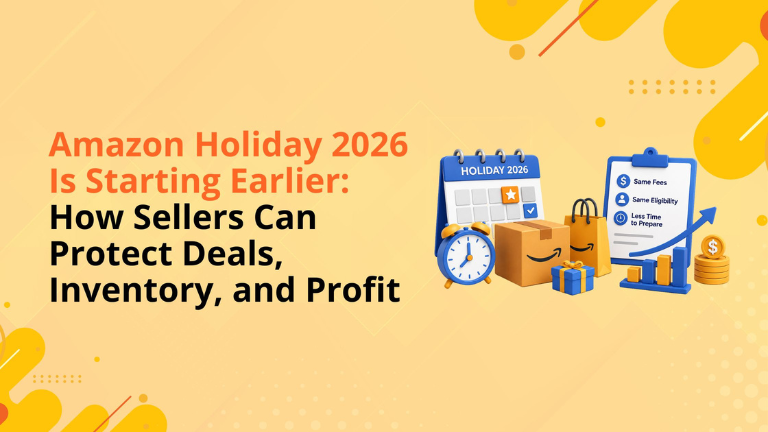
Amazon’s Holiday 2026 season may come with the same fees and eligibility rules, but sellers should not mistake that for a relaxed timeline.
This year, Prime Big Deal Days will return to start the holiday shopping season, followed by Black Friday Week and Cyber Monday. Amazon has already opened deal submissions and shared important inventory deadlines, fulfillment fee updates, and capacity planning guidance.
For sellers, the message is clear: Q4 preparation needs to start now.
Holiday success is not only about submitting a deal or increasing PPC budgets. Sellers need to plan inventory early, protect Prime eligibility, calculate peak-season fees, review margins, prepare listings, and make sure advertising is ready before traffic starts rising.
If sellers wait too long, they may miss deal deadlines, face inventory delays, lose Prime-badge visibility, or enter the busiest shopping season with weak profit control.
Many sellers think of Q4 as a promotional season.
In reality, it is also a fulfillment, pricing, inventory, and profitability test.
A product can have strong demand but still underperform if inventory arrives late. A deal can drive sales but still lose money if peak fees and ad costs are not included. A PPC campaign can bring traffic but waste budget if the listing is not ready to convert.
That is why Amazon Holiday 2026 planning should connect all major parts of the business.
A strong Amazon Store Management strategy helps sellers align deal planning, inventory movement, account health, advertising, and conversion readiness before peak season begins.
Amazon has opened the deal submission window for major Holiday 2026 events.
Prime Big Deal Days deal submissions are open from July 8 to September 8.
Black Friday Week and Cyber Monday deal submissions are open from July 8 to October 20.
Amazon is also bringing back the early submission discount. Sellers who submit Prime Big Deal Days deals by August 5 and Black Friday Week/Cyber Monday deals by September 5 can save on the upfront promotion fee.
This matters because early planning gives sellers more time to review ASIN eligibility, promotional pricing, inventory support, margin impact, and campaign readiness.
Waiting until the final deadline can create rushed decisions and weaker profitability.
Amazon has stated that there are no new eligibility requirements and that promotional fees for Best Deals, Lightning Deals, and Prime Exclusive Price Discounts will remain the same as Prime Day.
The structure includes an upfront promotion fee and a variable fee based on promotional sales.
Even if fees remain familiar, sellers still need to calculate profit carefully.
Holiday deals often combine multiple costs:
If sellers only look at revenue, a holiday promotion may look successful. But if margin is weak, the event may create volume without real profit.
Amazon has stated that Prime Big Deal Days promotional prices are excluded from the 30-day and 60-day lookback window and will not affect the maximum deal price required for Black Friday Week and Cyber Monday deals.
This gives sellers more flexibility when planning multiple holiday promotions.
However, sellers should still be careful.
Customers are becoming more price-aware, and price history is becoming easier to review. A product that is discounted too often may train shoppers to wait. A discount that is too weak may not convert. A discount that is too deep may damage profitability.
Holiday pricing should be planned around inventory, ranking goals, competitor pricing, and margin.
Holiday deals cannot perform if inventory is not ready.
Amazon has shared inbound inventory deadlines for Prime Big Deal Days, Black Friday Week, and Cyber Monday. These deadlines vary based on whether sellers use AWD, FBA shipments with minimal shipment splits, or FBA shipments with Amazon-optimized shipment splits.
For Prime Big Deal Days, sellers need inventory to arrive in September based on their selected shipment method.
For Black Friday Week and Cyber Monday, sellers need inventory to arrive in October based on the shipment method.
This means sellers cannot treat inventory planning as a last-minute task.
If inventory misses the inbound deadline, products may lose Prime eligibility, miss event traffic, or fail to support promotional demand.
Amazon fulfillment centers operate differently during Q4.
Amazon has noted that fulfillment center teams focus on receiving holiday shipments in September and October, then shift toward processing customer orders in November and December.
That means inventory sent late may face more pressure.
Sellers should review supplier lead times, production schedules, freight timelines, FBA shipment creation, receiving delays, replenishment speed, and forecasted sales volume.
Running a deal without enough inventory can create stockouts, ranking loss, wasted PPC momentum, and missed repeat-order potential.
Amazon Warehousing and Distribution can help sellers store extra inventory and replenish FBA as needed.
For sellers expecting higher holiday demand, AWD may be useful because it can support additional stock storage and automatic replenishment into fulfillment centers.
This can be especially helpful for brands with high-volume ASINs, seasonal products, bulky inventory, long lead times, or limited FBA capacity.
Sellers should compare AWD, FBA, 3PL, and FBM options before finalizing Q4 inventory strategy.
A stronger Multi-Channel Integration approach can also help brands manage inventory across Amazon, Shopify, Walmart, and other channels more effectively.
Holiday peak fulfillment fees will apply again from October 15, 2026, to January 14, 2027.
These fees apply across FBA, Remote Fulfillment with FBA, Multi-Channel Fulfillment, and Buy with Prime. Amazon has also stated that a fuel and logistics-related surcharge applies on top of holiday peak fulfillment fees.
This means sellers should update their profitability calculations before finalizing holiday pricing.
A deal that looked profitable using regular fulfillment fees may become weaker after peak fees, discounts, ad spend, and storage costs are included.
Sellers should use available tools such as the Revenue Calculator, Profit Analytics dashboard, and Fee and Economics Preview Report to compare fulfillment cost impact.
Holiday traffic can be expensive.
Many sellers increase PPC budgets during major shopping events, but ad spend must be connected to inventory and profitability.
Before scaling campaigns, sellers should check:
A strong Amazon Advertising PPC Services strategy should connect bids, budgets, promotions, inventory levels, and margin.
Otherwise, sellers may drive traffic that does not create profitable growth.
Holiday shoppers move quickly.
If your product page does not explain the offer clearly, customers may choose another listing. Before Q4 traffic increases, sellers should review product images, titles, bullets, A+ Content, reviews, comparison charts, pricing, and promotions.
Strong Amazon Content Optimization helps shoppers understand product value faster.
Better Amazon Image Optimization can also improve click-through rate and conversion by making the product easier to understand at a glance.
The time to fix listings is before the event, not after traffic has already started.
Sellers should treat Holiday 2026 planning as a timeline-based project.
Start by selecting the right ASINs for Prime Big Deal Days, Black Friday Week, and Cyber Monday.
Then calculate SKU-level profitability using deal price, fees, peak fulfillment costs, ad spend, and inventory costs.
Next, confirm inventory arrival deadlines based on your shipment method.
Review whether AWD, FBA, MCF, Buy with Prime, or a 3PL backup makes sense for your business.
Finally, prepare listings and PPC campaigns before traffic spikes.
This approach helps sellers reduce last-minute stress and improve the chance of profitable holiday performance.
We helps Amazon sellers prepare for Q4 with a full holiday growth strategy.
Our team reviews deal eligibility, promotional pricing, SKU-level margin, FBA fees, inventory deadlines, AWD planning, PPC campaigns, competitor positioning, listing content, and image readiness.
We help sellers prepare before deadlines become problems.
The goal is to protect profit, avoid stockouts, and make sure every holiday promotion has a clear business reason.
The major events include Prime Big Deal Days, Black Friday Week, and Cyber Monday.
Amazon has stated that fees for Best Deals, Lightning Deals, and Prime Exclusive Price Discounts remain the same as Prime Day.
Inventory must arrive by Amazon’s listed inbound deadlines to help protect Prime-badge eligibility during major holiday events.
Yes. Holiday peak fulfillment fees apply from October 15, 2026, to January 14, 2027, across major Amazon fulfillment services.
Yes, but only when inventory, margins, listing quality, and deal strategy can support the extra traffic.
Need help preparing your Amazon account for Holiday 2026?
Schedule a strategy call with our team.
Follow Big Internet Ecommerce (BIE) on Instagram & LinkedIn to stay updated with the latest trends in Amazon selling.
Fill out the form and our experts will get back
to you within 24 hours.
.webp)
.webp)
.webp)
We respect your privacy. Your information is safe with us.