July 29, 2026
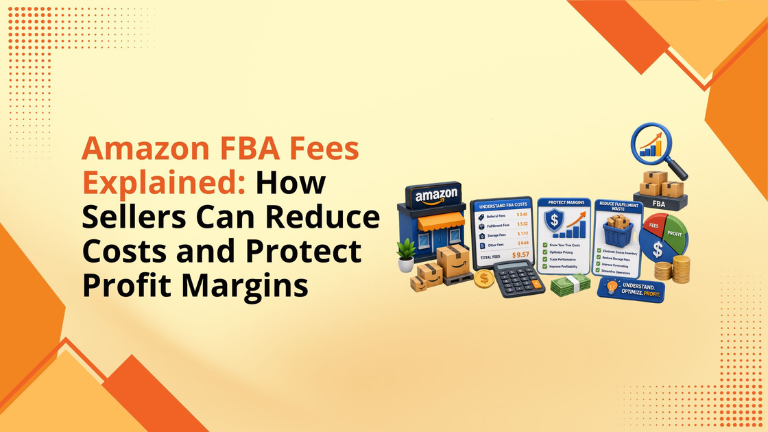
Amazon FBA Fees Explained: How Sellers Can Reduce Costs and Protect Profit Margins
Many Amazon sellers celebrate revenue first.
But revenue does not tell the full story.
A product may generate consistent sales, rank well, and receive strong traffic, but still leave the seller with weak margins after Amazon FBA fees, referral fees, storage costs, return costs, advertising spend, and product costs are deducted.
That is where many sellers lose control.
Fulfillment by Amazon is one of the most useful programs available to sellers. It helps brands outsource storage, picking, packing, shipping, customer service, and eligible returns. It can also support faster delivery and a better customer experience.
But FBA is not free, and it is not one simple fee.
To grow profitably, sellers need to understand how Amazon FBA costs work, what drives those costs higher, and what actions can reduce unnecessary expenses.
This guide explains the key FBA cost areas and how Amazon sellers can manage them more strategically.
Amazon FBA fees are the costs sellers pay when they use Fulfillment by Amazon to store and ship products.
When a seller sends inventory to Amazon’s fulfillment network, Amazon manages key parts of the fulfillment process. Once a customer places an order, Amazon picks the item, packs it, ships it, and handles eligible customer service and returns.
The main FBA cost categories include:
These costs can vary based on the product’s size, weight, category, packaging, storage duration, and inventory movement.
Amazon sellers should understand the difference between selling fees and FBA costs.
Selling fees are the standard charges for selling on Amazon. These may include a selling plan fee, referral fees, and other marketplace-related fees.
FBA costs are tied to fulfillment services. These apply when sellers choose to use Amazon’s fulfillment network.
In simple terms:
Selling fees help you access the Amazon marketplace.
FBA costs help you use Amazon’s fulfillment system.
Both affect profit.
A seller cannot accurately calculate margin by looking at only one of them.
FBA fees directly affect product profitability.
A seller may have a product with strong demand, but if the item is large, heavy, slow-moving, or poorly packaged, fulfillment and storage costs can reduce the profit significantly.
This is especially important for sellers who are scaling PPC.
If advertising spend increases while FBA fees are already high, the product may generate more sales but less actual profit.
That is why every Amazon seller should track contribution margin, not just revenue or ACoS.
A healthy Amazon strategy should answer:
Without these answers, sellers may scale the wrong products.
FBA fulfillment fees cover the cost of picking, packing, shipping, customer service, and eligible returns.
These fees are usually based on product size and weight.
That means packaging decisions matter.
A product that moves into a larger size tier may cost more to fulfill, even if the product itself is not expensive. For sellers with tight margins, this can make a major difference.
Before launching or restocking a product, sellers should review whether the item’s dimensions and weight are optimized.
Sometimes a small packaging adjustment can improve profitability across hundreds or thousands of units.
Amazon charges monthly storage fees based on the space your inventory uses in its fulfillment network.
Storage costs are typically calculated by cubic feet.
This means slow-moving inventory becomes expensive over time.
The longer products sit in Amazon warehouses, the more they can affect cash flow and profitability. Storage costs may also increase during high-demand periods such as Q4, when fulfillment center space becomes more valuable.
For sellers, the goal is not to send as much inventory as possible.
The goal is to send the right inventory at the right time.
Aged inventory costs can hurt sellers who overstock or fail to manage slow-moving products.
If inventory remains in Amazon’s fulfillment network for too long, sellers may face additional charges. These costs can turn a once-profitable product into a margin problem.
This often happens when sellers:
Good inventory planning can prevent many of these issues.
Storage costs can become more important during peak shopping seasons.
During periods like Black Friday, Cyber Monday, and the holiday season, sellers need to plan inventory carefully. Sending too much stock too early can increase storage costs, while sending too little can lead to stockouts.
Both problems hurt performance.
Overstocking increases fees.
Stockouts reduce ranking, sales, and PPC momentum.
The best sellers plan seasonal inventory based on sales velocity, lead times, ad strategy, and expected demand.
Not every product is ideal for FBA.
Sellers should evaluate FBA suitability before launching or expanding a catalog.
Products that often work better for FBA include:
Products that are bulky, fragile, low-margin, slow-moving, or expensive to store require more careful planning.
Amazon sellers should not choose products only because demand looks strong. They should choose products that can remain profitable after all costs are included.
For low-priced products, Amazon may offer lower FBA rates when items qualify.
This can help sellers offer affordable products without damaging margin too much.
For sellers selling products under lower price points, this can be useful when expanding a product line or competing in price-sensitive categories.
However, sellers should still calculate total margin carefully.
Lower FBA rates can help, but they do not replace strong pricing, efficient packaging, and disciplined inventory planning.
Packaging is one of the most overlooked areas of FBA profitability.
Poor packaging can increase product dimensions, add unnecessary weight, and push items into higher fulfillment cost brackets.
Sellers should aim for packaging that is:
For some products, polybags, flat packaging, or slimmer cartons may reduce costs compared to oversized boxes.
The key is to reduce waste without creating damage, returns, or poor presentation.
Amazon offers programs that can help sellers reduce certain fulfillment-related costs.
These may include options such as Partnered Carrier, stickerless inventory where eligible, and Ships in Product Packaging.
Each program has a different purpose.
A partnered Carrier can help sellers reduce inbound shipping costs when sending inventory to Amazon.
Stickerless inventory may help eligible products avoid extra labeling steps.
Ships in Product Packaging may reduce additional packaging material when the product’s own packaging is suitable for delivery.
Before using any program, sellers should confirm eligibility, compliance, product protection, and customer experience.
Cost savings should never create a higher return rate.
The FBA Revenue Calculator is a useful tool for estimating fees, costs, and net profit.
Sellers should use it before:
The calculator can help sellers compare estimated costs and understand whether a product has enough profit potential.
However, sellers should also compare estimates with actual reports after sales begin.
Estimated margin and real margin are not always the same.
Sellers can preview FBA fees in Seller Central through fulfillment reports.
This helps sellers understand expected FBA costs across their catalog.
A regular fee review should be part of every Amazon account management routine.
At minimum, sellers should review:
This should not be done only once a year.
For active sellers, profitability review should happen monthly, and high-risk SKUs should be reviewed more often.
Many FBA cost problems are preventable.
The most common mistakes include:
These mistakes can quietly reduce profit even when sales look healthy.
Sellers can reduce FBA costs by improving how they manage inventory, packaging, pricing, and product selection.
Start with inventory discipline.
Do not overstock based on hope. Use sales velocity, seasonality, lead time, and PPC plans to decide replenishment quantities.
Next, improve packaging.
Check whether product size and weight can be reduced while still meeting Amazon requirements and protecting the item.
Then review pricing.
If FBA fees increase and pricing stays the same, margin may shrink. Sellers should review whether the product price still supports profitability.
Finally, remove or discount slow-moving inventory before it becomes expensive.
Sometimes protecting cash flow is more important than holding inventory for too long.
PPC performance cannot be judged properly without understanding FBA costs.
A campaign may look acceptable based on ACoS, but once FBA fees, COGS, referral fees, and storage costs are included, the product may not be profitable.
This is why sellers should track TACoS, contribution margin, net profit, and inventory movement together.
A strong Amazon PPC strategy should focus on profitable growth, not just sales volume.
Big Internet Commerce helps sellers connect PPC performance with operational profitability so advertising decisions are based on real margin.
We help Amazon sellers identify where profit is being lost and where growth can be improved.
Our team reviews the full Amazon account structure, including listings, SEO, PPC, catalog health, inventory movement, product profitability, FBA cost exposure, and marketplace growth opportunities.
For FBA sellers, we help analyze:
The goal is simple.
We help sellers stop guessing and start managing Amazon with clearer numbers, stronger systems, and better profit control.
Amazon FBA fees are the costs sellers pay when Amazon stores, picks, packs, ships, and handles eligible service for customer orders.
Selling fees are marketplace-related charges for selling on Amazon. FBA costs are fulfillment-related charges for using Amazon’s fulfillment network.
Sellers can reduce costs by improving packaging, avoiding overstocking, monitoring slow-moving inventory, using cost-saving programs, and choosing products with better size, weight, and margin profiles.
Storage fees matter because slow-moving inventory takes up warehouse space and can reduce profitability over time.
Yes. Sellers should use it before launching, repricing, restocking, or scaling advertising so they can estimate net profit more accurately.
Want to know whether your Amazon products are truly profitable after FBA fees, PPC spend, and inventory costs?
Schedule a strategy call with our team.
Follow Big Internet Ecommerce (BIE) on Instagram & LinkedIn to stay updated with the latest trends in Amazon selling.
Fill out the form and our experts will get back
to you within 24 hours.
.webp)
.webp)
.webp)
We respect your privacy. Your information is safe with us.