August 17, 2026
Amazon DSP Is Moving Into One Advertiser Account: What Sellers Should Check Before Scaling Globally
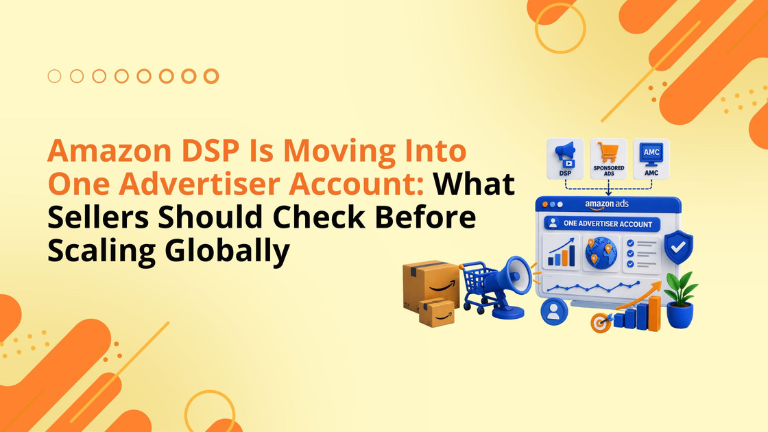
Amazon advertising is becoming more connected.
For years, many sellers treated Sponsored Ads and Amazon DSP as separate worlds.
Sponsored Products, Sponsored Brands, and Sponsored Display lived closer to the seller’s day-to-day PPC workflow. Amazon DSP often sat in a more advanced media-buying environment, usually handled by agencies, enterprise teams, or brands with more mature advertising systems.
That gap is now getting smaller.
Amazon Ads is moving toward a more unified advertiser account experience that brings Amazon DSP, Sponsored Ads, Amazon Marketing Cloud access, billing, permissions, and reporting closer together.
For growing sellers, this is a meaningful change.
It can make global advertising easier to activate.
It can reduce account setup friction.
It can simplify access management.
It can bring programmatic and Sponsored Ads reporting closer together.
It can help teams connect upper-funnel and lower-funnel strategy more clearly.
But it also creates a new challenge.
When access becomes easier, spend can scale faster than strategy.
That is why sellers need to understand what is changing, what to check, and how to protect performance before expanding into more markets or adding more DSP activity.
The Amazon Ads advertiser account is an enhanced account structure designed to simplify advertising management across Amazon ad products and supported countries.
Amazon’s official guidance explains that the advertiser account can help advertisers manage Amazon DSP and Sponsored Ads activity through a more unified structure.
For existing Amazon DSP advertisers, Amazon states that DSP advertiser account IDs can be upgraded into the advertiser account experience without requiring a new account creation process.
This means eligible advertisers can continue running existing campaigns while gaining access to a more streamlined account experience.
The advertiser account can support:
For agencies and larger teams, this can reduce the manual work involved in managing campaigns across different products and markets.
For sellers, it can make advanced advertising more accessible.
This update is not simply a new dashboard label.
It changes how advertisers may organize and manage Amazon Ads activity.
The advertiser account can bring together several major pieces of the advertising workflow.
Programmatic buying can sit closer to Sponsored Ads activity.
Amazon DSP and Sponsored Ads can be managed with less account switching.
Amazon Marketing Cloud access can be provisioned through the advertiser account, making it easier to connect analytics across products and regions.
Billing settings and invoice access can be managed more centrally.
Permissions can be assigned through standardized roles such as admin, editor, viewer, or custom controls.
For teams that manage multiple markets, the account can support global reach while still allowing country-level campaign decisions within Amazon DSP.
This is useful because it reduces operational friction.
But it also means sellers need stronger internal control.
When more products, countries, invoices, and users sit in one structure, mistakes can spread faster if the account is not reviewed properly.
Amazon Ads has been expanding beyond traditional retail media.
Sponsored Products remains the core channel for many sellers, but brands increasingly need a fuller media strategy.
That may include:
The old fragmented setup made this harder.
Advertisers often needed separate account structures, separate billing workflows, separate registrations, and separate permissions across products and markets.
Amazon’s enhanced advertiser account reduces that friction.
From Amazon’s perspective, this makes the platform easier to adopt and easier to scale.
From a seller’s perspective, it creates an opportunity to connect retail media strategy more professionally.
For sellers, this update matters because DSP can now feel closer to the normal Amazon advertising workflow.
A mid-size brand that already runs Sponsored Products and Sponsored Brands may start asking whether it should also run DSP for retargeting, audience building, or upper-funnel demand generation.
That is a fair question.
DSP can help brands reach audiences beyond standard search placements. It can support remarketing, display, video, and audience-based campaigns.
But DSP should not be used casually.
Sponsored Products often captures existing demand.
DSP can help create, influence, or re-engage demand.
That means the measurement approach needs to be different.
If sellers judge DSP only by immediate ACOS, they may miss its role in the funnel.
If sellers ignore contribution margin, they may overspend.
If sellers blend all countries together, they may hide weak markets behind stronger ones.
If sellers launch DSP without creative testing, the campaign may never get a fair chance.
The opportunity is real, but so is the need for discipline.
One of the biggest risks of unified access is false confidence.
When an account makes it easier to reach multiple markets, sellers may feel tempted to expand quickly.
But every marketplace has different economics.
A campaign that works in the U.S. may not work the same way in Canada, the U.K., Germany, Japan, or Australia.
Differences may include:
A blended dashboard can make performance look acceptable while one market quietly carries the loss.
That is why sellers should review marketplace-level performance before and after account consolidation.
If your Amazon DSP account has moved into the advertiser account experience, do not start by launching new markets.
Start by checking the foundation.
Review the account selector.
Confirm where the upgraded account appears and whether the team understands the new navigation.
Review user roles.
Make sure the right people have the right access. Admin access should be limited. Editors should be assigned carefully. Viewers should include reporting, leadership, and finance stakeholders where needed.
Review billing ownership.
Confirm where invoices are generated, who receives them, and whether finance has visibility across DSP and Sponsored Ads spend.
Snapshot current performance.
Before making changes, save a clean baseline for the last 30 days by marketplace, campaign type, product line, spend, sales, ACOS, ROAS, orders, and contribution margin.
Review AMC access.
If AMC is available through the advertiser account, decide how it will be used. Do not treat AMC as an afterthought. It can help connect Sponsored Ads, DSP, audience behavior, and path-to-purchase analysis when set up properly.
Define expansion rules.
Before testing new countries, decide what qualifies a SKU or product line for DSP expansion.
That rule should include margin, conversion rate, inventory coverage, creative readiness, review strength, and marketplace opportunity.
Unified account access may change the way clients think about Amazon DSP.
Some brands may assume that if the account is easier to access, DSP management should also become simple.
That is not accurate.
The setup may become easier, but the strategic work remains important.
Agencies still need to manage:
A unified account reduces platform friction. It does not replace media strategy.
This is an important point for sellers working with an agency.
If access changes, ask what changes in the scope of work.
A good agency should be able to explain whether the management fee covers setup, audience strategy, creative testing, reporting, AMC analysis, marketplace expansion, or only campaign execution.
Sellers should avoid treating this update as permission to scale spend immediately.
Do not launch multiple countries without a marketplace-level plan.
Do not combine all performance into one blended number.
Do not let every team member keep admin access.
Do not ignore billing changes.
Do not assume AMC access means AMC insights are automatically being used.
Do not run DSP to weak listings.
Do not use the same creative across every market without checking local relevance.
Do not judge DSP only through short-term ACOS.
Do not expand to new markets without checking inventory, pricing, reviews, and contribution margin.
Amazon Ads may be simplifying the account structure, but performance still depends on fundamentals.
For mid-size sellers, this update can be positive.
It may help brands that are ready to move beyond basic PPC and build a more complete Amazon media strategy.
A mature brand can use this structure to connect:
This creates a more complete advertising system.
But the brand needs the right foundation first.
That foundation includes optimized listings, strong images, clean A+ Content, stable inventory, healthy reviews, clear pricing, and defined margin targets.
Without those pieces, DSP can amplify existing weaknesses.
DSP may drive traffic, but the listing still needs to convert.
If the product detail page is weak, paid media efficiency suffers.
Before scaling DSP, sellers should review:
A strong ad system cannot fully compensate for a weak product page.
This is why Big Internet Commerce looks at PPC, SEO, creative, catalog health, and account structure together.
We help Amazon brands grow through PPC management, Amazon SEO, listing optimization, A+ Content, image optimization, Store Management, catalog audits, and full-service marketplace support.
Amazon’s advertiser account update is useful because it can make campaign management more connected.
But the brands that benefit most will be the ones that connect access with strategy.
That means asking better questions:
We help sellers answer these questions before spend expands.
Before widening Amazon DSP activity, review these areas carefully.
Check account access.
Confirm admin, editor, viewer, and custom permissions. Remove users who no longer need access.
Check billing setup.
Make sure finance knows where invoices live and how DSP and Sponsored Ads billing will be handled.
Check marketplace baselines.
Pull spend, sales, ACOS, ROAS, orders, conversion rate, and contribution margin by marketplace.
Check product readiness.
Only promote SKUs that have enough reviews, strong content, healthy inventory, stable pricing, and clear margin room.
Check creative readiness.
DSP needs strong visual and message testing. Do not rely only on old Sponsored Ads creative assumptions.
Check AMC planning.
If AMC is available, define what questions it should answer before launching more spend.
Check reporting discipline.
Separate performance by country, funnel stage, product line, audience, and creative theme.
Check expansion rules.
Write down the conditions required before launching DSP in a new market.
The advertiser account is Amazon’s enhanced account structure for managing Amazon DSP, Sponsored Ads, billing, permissions, reporting, and AMC access through a more unified experience.
Amazon’s guidance says existing DSP advertiser accounts can be automatically upgraded into the advertiser account experience with no new account creation required.
Yes. Amazon says AMC access can be provisioned through the advertiser account, making cross-product and cross-region analytics easier to connect.
Not automatically. Sellers should first review listing quality, margins, inventory, creative readiness, and reporting before expanding DSP spend.
Agencies need to explain what unified access changes and what it does not change. Audience strategy, creative testing, reporting, AMC analysis, and budget control still require expert management.
Start with user roles, billing ownership, account navigation, marketplace-level spend, product margin, and campaign baselines.
Yes. If sellers only review blended results, one strong country can hide losses in another. Marketplace-level reporting is still essential.
We can review PPC performance, DSP readiness, creative strategy, listing quality, catalog health, and marketplace expansion opportunities before sellers scale spend.
Amazon Ads is making it easier to manage DSP, Sponsored Ads, AMC access, billing, permissions, and global advertising activity through a more unified advertiser account.
That is good news for sellers who are ready to manage advertising more strategically.
But easier access does not automatically create better performance.
It can also make it easier to overspend, blend weak markets into strong ones, and scale campaigns before listings, margins, and measurement are ready.
If your brand is considering Amazon DSP or expanding across markets, start with the fundamentals.
Review account access.
Review billing.
Review marketplace-level performance.
Review product margins.
Review creative readiness.
Review AMC measurement.
Review listing quality.
We can help Amazon sellers audit PPC, DSP readiness, listing performance, catalog health, creative assets, and marketplace growth opportunities.
Schedule a strategy call with our team.
Follow Big Internet Ecommerce (BIE) on Instagram & LinkedIn to stay updated with the latest trends in Amazon selling.
Fill out the form and our experts will get back
to you within 24 hours.
.webp)
.webp)
.webp)
We respect your privacy. Your information is safe with us.