June 25, 2026
Alexa+ Agentic Ads: Why Amazon Sellers Must Prepare for Purchases Without the Product Page
Amazon Advertising Is Moving Into Conversational Commerce
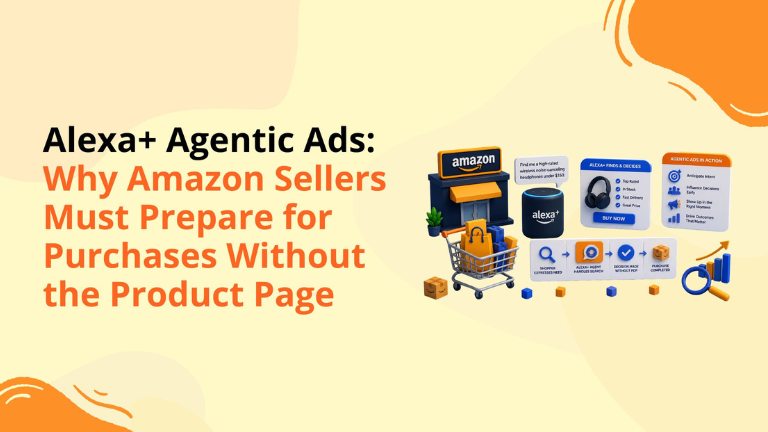
Amazon has introduced Alexa+ Agentic Ads, a new ad format that allows shoppers to interact with an ad and complete a purchase through Alexa+.
For Amazon sellers, this is not just another ad placement. It is a change in how shoppers may discover, evaluate, and buy products.
Traditionally, the product detail page carried most of the conversion work. Shoppers clicked an ad, reviewed images, read bullets, checked A+ Content, compared price, and then decided whether to purchase.
With agentic ads, that journey can become much shorter. A shopper may ask Alexa+ a question, receive a recommendation, choose a variation, and complete the transaction inside the ad experience.
This matters because many Amazon strategies are built around the product detail page.
Sellers optimize images, bullets, A+ Content, comparison charts, reviews, and FAQs to increase conversion after the click. But when a purchase happens inside a conversational ad, some of those traditional touchpoints may not be seen.
That does not make listing optimization less important.
It makes structured product information even more important.
Alexa+ needs clear product data to answer shopper questions, explain differences, support variation choices, and justify the purchase.
A listing review through Amazon Content Optimization can help sellers make product information clearer, more searchable, and easier for AI-assisted shopping systems to interpret.
In this new environment, your product attributes can act like ad copy.
Details such as size, material, ingredients, compatibility, benefits, use cases, variation differences, pricing, and Q&A may influence how Alexa+ explains your product during the buying conversation.
If your product data is incomplete, outdated, or inconsistent, your ad experience may become weaker.
For example, if shoppers ask whether the larger size is worth the extra cost, Alexa+ needs accurate size, price, value, and feature information to answer clearly.
This is why sellers should review product data across titles, bullets, backend fields, images, A+ Content, and product attributes.
Alexa+ Agentic Ads may also change how sellers evaluate ad performance.
If a shopper completes the purchase inside the ad, there may be no traditional PDP visit, add-to-cart journey, or post-click retargeting path.
That means sellers should not measure these conversions exactly the same way they measure regular Sponsored Ads or DSP activity.
A proper review through Amazon Advertising PPC Services can help sellers separate campaign types, monitor cost per conversion, and understand whether new ad formats are improving real profitability.
First, audit your top-performing ASINs. Focus on products with strong velocity, high ad spend, or strong Prime Day and seasonal performance.
Second, clean up structured fields. Review titles, bullets, dimensions, materials, ingredients, compatibility, variation names, and Q&A.
Third, improve product visuals. Even if the purchase happens inside a conversation, strong Amazon Image Optimization still supports trust across search, product pages, and other ad surfaces.
Fourth, separate reporting where possible. Echo Show and Alexa-driven conversions should be evaluated against their own cost, order value, and profit impact.
Fifth, rebuild the contribution margin. If in-ad checkout reduces upsell or bundle opportunities, sellers need to know whether the conversion path is truly profitable.
Big Internet Ecommerce helps Amazon sellers prepare for the next stage of AI-driven commerce.
Our team reviews product listings, structured attributes, PPC performance, DSP readiness, product images, content quality, and SKU-level profitability.
Through Amazon Store Management, we help sellers connect catalog quality, advertising performance, and conversion strategy into one growth system.
The goal is simple: help your products stay visible, understandable, and profitable as Amazon shopping becomes more conversational.
Alexa+ Agentic Ads are Amazon ad experiences that allow shoppers to interact with Alexa+ and complete purchases inside the ad conversation.
Because some shoppers may buy without visiting the product detail page, which changes how sellers think about content, attribution, and conversion tracking.
Start with top ASIN product data, including titles, bullets, attributes, Q&A, variations, pricing, and content consistency.
Need help preparing your Amazon catalog for AI-powered shopping?
Schedule a strategy call with our team.
Follow Big Internet Ecommerce (BIE) on Instagram & LinkedIn to stay updated with the latest trends in Amazon selling.
Fill out the form and our experts will get back
to you within 24 hours.
.webp)
.webp)
.webp)
We respect your privacy. Your information is safe with us.